




HOME > Case > Energy > Power Distribution Monitoring and Photovoltaic Systems
Against the accelerating energy transition, power distribution systems and photovoltaic generation are increasingly shifting toward distributed and intelligent architectures. More assets are being deployed across urban edges, commercial and industrial rooftops, and remote areas, making reliable connectivity and efficient remote O&M essential for the power and renewable energy sectors.
In practical deployments, 4G/5G-based industrial router solutions have become a widely adopted and mature communication approach for power distribution monitoring and photovoltaic (PV) systems.
1. Communication Characteristics in Distributed Energy Systems
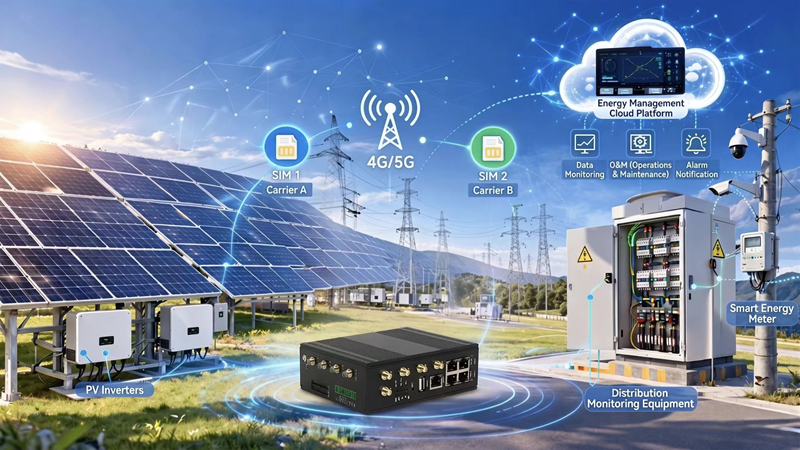
Both power distribution terminals and photovoltaic (PV) plants exhibit clear distributed communication characteristics. Devices are widely deployed across urban, rural, and remote areas such as rooftops, mountains, and deserts, where wired connectivity is often difficult or, even when available, cost- and time-prohibitive.
At the same time, high availability is essential. Power equipment must operate reliably over the long term, and any communication interruption may impact not only data collection but also dispatching and control.
In addition, power data is security-sensitive, requiring reliable encryption and strict access control during transmission.
2. Cellular Network–Based Communication Architecture
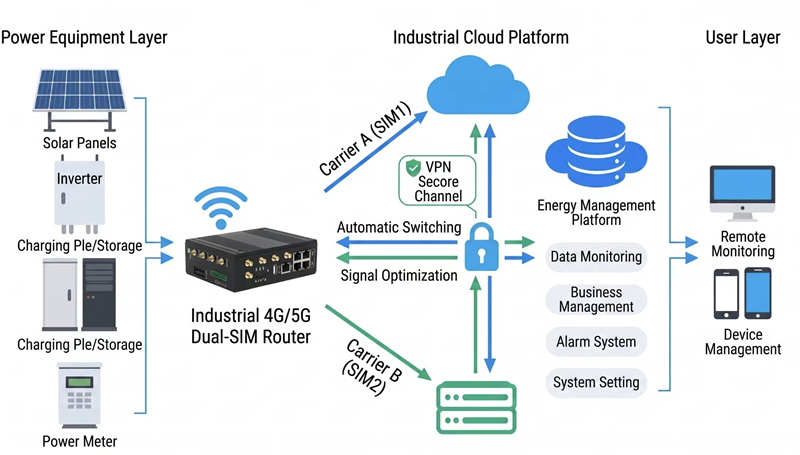
In a typical deployment, the industrial router serves as the core communication unit, bridging field devices and remote platforms to establish a complete data transmission path. The overall architecture can be described as:
Power Equipment → Industrial Router → 4G/5G Network → Cloud Platform / Dispatching System
This architecture is usually fully based on cellular networks, without relying on wired connections. To further enhance reliability, dual-SIM redundancy is commonly adopted, enabling backup and switching between different carrier networks. When the primary network becomes unstable or unavailable, the router can automatically switch to the secondary SIM, ensuring continuous device connectivity.
3. Typical Applications
3.1 Distribution Automation System
In power distribution networks, various terminal devices (such as DTUs and FTUs) are required to transmit operational data to the dispatching center in real time, while also receiving control commands.
Industrial routers leverage 4G/5G networks to provide a stable communication channel for these devices, enabling:
· Real-time acquisition of key parameters such as voltage and current
· Remote control of switching equipment
· Rapid reporting of fault information
This wireless communication approach is particularly critical in rural grid upgrades and urban fringe areas.
3.2 Distributed Photovoltaic Power Plants
In photovoltaic (PV) systems, industrial routers are typically deployed in conjunction with inverters or data loggers to transmit generation data to cloud platforms. With stable wireless connectivity, the following can be achieved:
· Real-time monitoring of power generation and operational status
· Power plant performance analysis
· Fault early warning and remote diagnostics
For unattended photovoltaic (PV) power plants, such remote capabilities are critical to ensuring efficient system operation.
3.3 Energy Storage and Renewable Energy Systems
In energy storage systems or charging infrastructure, industrial routers likewise play a key role in data transmission and remote management. They enable integration with Energy Management Systems (EMS), supporting real-time device monitoring and optimized dispatching.
4. Key Technical Features
4.1 Dual-SIM Redundancy
In the absence of wired network support, communication reliability primarily depends on the cellular network itself.
Industrial routers equipped with a dual-SIM design can connect to networks from different carriers and automatically switch based on network quality. This mechanism effectively mitigates communication interruptions caused by single-network failures, serving as a key safeguard for improving system availability.
4.2 Stable Cellular Network Connectivity
For complex outdoor environments, industrial routers are typically equipped with:
· Multi-band support for compatibility with networks across different regions
· Optimized performance in weak signal environments
· Long-term stable operation with high uptime
Ensuring stable device connectivity under various environmental conditions.
4.3 Industrial Reliability Design
To meet the long-term operational requirements of the power industry, industrial routers are designed with:
· Hardware watchdog mechanism for system stability
· Automatic reboot and link recovery capabilities
· Wide operating temperature range
Ensuring continuous and stable operation in unattended environments.
4.4 Secure Communication Mechanism
Through technologies such as VPN, encrypted communication channels can be established between devices and platforms, enabling:
· Secure data transmission
· Access control and authorization
· Prevention of unauthorized access
4.5 Remote Management and Operation & Maintenance Capabilities
With the support of a remote management platform, operations and maintenance personnel can centrally manage devices, including:
· Online status monitoring
· Network quality analysis
· Remote configuration and firmware upgrade
· Traffic and SIM card management
In distributed energy scenarios such as power distribution monitoring and photovoltaic (PV) systems, industrial routers provide reliable connectivity through stable 4G/5G, dual-SIM redundancy, and remote management. WLINK’s full range of 4G/5G industrial routers is widely deployed across applications including power distribution, PV systems, and energy storage.
Related products
· Support 5G SA/NSA, LTE-Pro Cat 20/15 Ultra Speed Network
· MIPS Dual-core 880MHz, 256Mb Flash, 4Gb DDR3 RAM
· Compact and powerufl Industrial grade design
· 2xGbE, 1xRS232/485
· Ideal for eMBB , uRLLC and massive IoT use cases
· Optional OpenWrt OS
· Support 5G SA/NSA Ultra Speed Network
· Dual-code 1Ghz CPU, 256Mb Flash, 4Gb DDR3 RAM
· Ultra-Reliable Low-Latency
· 5xGigabit Ethernet (GbE), 1x RS232/485
· Multi-constellation GNSS receiver (optional) available
· Designed for robust and versatile connectivity.
CONTACT US
- +86-755-86089513
- +86-755-86089513
- 2A, F5 Building, TCL International E-city, Zhongshanyuan Rd, Nanshan, Shenzhen, China 518022
- Sales@wlink-tech.com
Subscribe to Our Newsletter
Get information of our newest products and promotions


Copyright @ 2013 - 2026 Shenzhen Wlink Technology Co., Ltd.