




HOME > Case > Energy > Highly Reliable Dual-Layer Network for Battery Energy Storage Systems
1. Industry Overview
Driven by the global transition to renewable energy and increasing power market volatility, the deployment of Battery Energy Storage Systems (BESS) is accelerating rapidly. Whether in Commercial & Industrial (C&I) applications or grid-scale storage, a BESS is no longer just a passive "giant battery"—it is a dynamic, distributed energy asset that actively responds to grid demands.
Unlocking the full potential of these high-value assets relies entirely on a robust, low-latency, and interference-resistant industrial IoT "nervous system" capable of millisecond-level precision.
2. Core Challenges in BESS Deployment
System integrators and operators frequently encounter the following connectivity bottlenecks in the field:
Thermal Runaway Risks: The complex internal environment of battery cabinets requires continuous monitoring of cell temperature and voltage. Any data latency or packet loss can delay critical warnings, leading to catastrophic safety failures.
Real-Time Grid Dispatch: Participating in Virtual Power Plant (VPP) operations or peak-shaving demands that the Energy Management System (EMS) responds to grid commands instantly. This requires exceptional network stability and ultra-low latency.
Extreme Environmental Stress: BESS containers are often deployed in remote, harsh locations—from freezing high-altitude regions to scorching deserts. Equipment must survive severe Electromagnetic Interference (EMI) and extreme temperature cycles that would cause commercial-grade hardware to fail.
3. The Dual-Layer Reliability Architecture in WLINK Solution
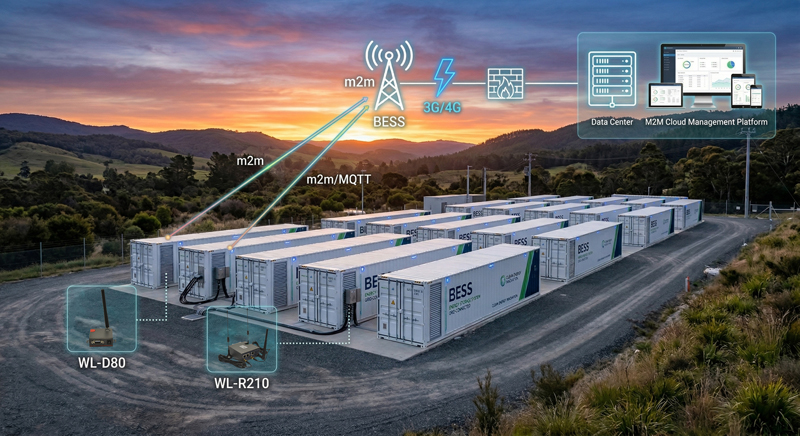
To guarantee absolute safety and maximize operational revenue, we provide a synergistic communication architecture powered by the WL-D80 4G DTU and the WL-R210 4G Industrial Router.
The Telemetry Layer: WL-D80 4G DTU
Serving as the first line of defense, the WL-D80 integrates directly with the BMS (Battery Management System). This rugged cellular modem supports RS-232, RS-485, RS-422, or TTL interfaces and utilizes PPP, TCP/IP, and UDP protocols to establish a complete transparent data channel. With a wide power input range (5-26V) and ultra-low power consumption (as low as 17mA at 12V in idle mode), it is ideal for continuous telemetry in isolated battery clusters.
The Edge Dispatch Layer: WL-R210 4G Industrial Router
The WL-R210 acts as the primary edge gateway, connecting the EMS to central cloud platforms and grid control centers. It delivers high-speed 4G connectivity with download speeds up to 150Mbps and features dual SIM slots for automatic network failover. To ensure data security, it supports advanced VPN protocols including WireGuard, Zerotier, IPsec, OpenVPN, GRE, L2TP, and PPTP. Equipped with a hardware watchdog and multi-link detection, the R210 ensures the system remains "always online" even in the most demanding environments.
4. Key Customer Benefits
Extreme Climate Resilience: Both the WL-D80 and WL-R210 are engineered for industrial-grade endurance, featuring a wide operating temperature range of -30°C to +75°C. This ensures 24/7 uninterrupted performance in both arctic-cold and desert-heat environments.
Predictive Safety: Reliable data streams eliminate monitoring blind spots, allowing for real-time telemetry to prevent thermal runaway before it starts.
Maximized ROI: By guaranteeing zero-latency communication for demand response and ancillary services, our hardware turns a static storage unit into a highly profitable, active grid participant.
EMI-Hardened & Robust Design: Housed in durable, compact metal casings, these devices are built to withstand strong electromagnetic interference and physical shock common in power cabinets.
Versatile Integration: With support for industrial protocols like Modbus TCP and flexible I/O ports, our solution seamlessly connects with PLCs, sensors, and meters within the BESS ecosystem.
5. Conclusion
In the energy storage sector, data connectivity is the bridge between safety and profitability. With our field-proven, wide-temperature industrial communication hardware, we provide the ultimate data foundation for energy aggregators and BESS integrators worldwide.
-- The end
CONTACT US
- +86-755-86089513
- +86-755-86089513
- 2A, F5 Building, TCL International E-city, Zhongshanyuan Rd, Nanshan, Shenzhen, China 518022
- Sales@wlink-tech.com
Subscribe to Our Newsletter
Get information of our newest products and promotions


Copyright @ 2013 - 2026 Shenzhen Wlink Technology Co., Ltd.