





HOME < Technology < Python in Industrial IoT Router
In today's rapidly evolving industrial IoT, enterprises' demands for digitalization and intelligence have moved beyond mere data collection or remote connectivity. More and more application scenarios require gateway devices not only to connect but also to perform "computing," "analysis," "decision-making," and "automatic control." As a result, industrial IoT gateways with edge computing capabilities have become the market's focal point. Among these, industrial gateways that support a Python runtime environment offer unique advantages in flexibility and development efficiency, providing customers with a brand‑new, on‑demand functional development model
Why Python?
Python is an interpreted, object-oriented, high-level programming language with dynamic semantics. Its simple, easy to learn syntax emphasizes readability and therefore reduces the cost of program maintenance. Python supports modules and packages, which encourages program modularity and code reuse. The Python interpreter and the extensive standard library are available in source or binary form without charge for all major platforms and can be freely distributed.
Compared with traditional embedded languages such as C/C++ and Java, Python's advantages in the industrial field are mainly reflected as follows.
Low learning curve
Python's simple syntax and clear structure allow even non-professional developers to master it in a short time. For system integrators and automation engineers, it is accessible without requiring deep programming expertise.
Rich third-party libraries
Whether it is Modbus-tk and PySerial for protocol handling, NumPy and Pandas for mathematical operations, or MQTT libraries for cloud connectivity, Python offers ready-to-use tools for nearly every industrial scenario.

Convergence of IT and OT
As the most popular language in the IT field, deploying Python on gateways enables IT engineers to directly participate in OT (production technology) data processing, breaking down the technical barriers between the two domains.
What Can We Do with Python?
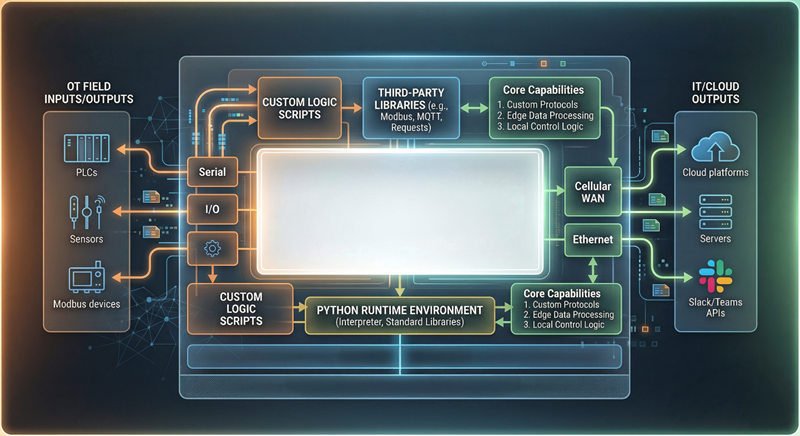
A Python-enabled industrial gateway/router essentially integrates a lightweight or full-featured Python interpreter into its embedded system (e.g., Linux). This provides customers with unprecedented flexibility.
Flexible Protocol Customization
Although the gateway comes with mainstream protocols like Modbus, OPC UA, and Profinet, non-standard or proprietary protocols are often encountered on site. With the Python environment, customers can write their own driver scripts to parse raw data from specific sensors or legacy equipment, enabling "connectivity to virtually anything.”
Edge Data Cleaning and Preprocessing
Industrial field data is massive and messy. Uploading all data to the cloud would cause significant bandwidth pressure and high costs.
Filtering & Noise Reduction: Use Python to filter out duplicate or invalid data.
Threshold Alarming: Determine locally whether values exceed thresholds, enabling millisecond-level local alarms without waiting for cloud responses.
Local Service Logic Implementation
In some scenarios, the gateway acts as a small-scale controller. For example, when the pressure of Sensor A exceeds 10 MPa and the temperature of Sensor B continues to rise, a Python script can automatically send a shutdown command to the actuator and simultaneously push a WeChat message to O&M personnel.
Typical Applications of Python
Scenario 1
Offline Breakpoint Resume and Cache Management
In remote areas with poor network conditions (e.g., photovoltaic plants, mines), Python scripts take over the gateway's storage. When a network interruption is detected, Python automatically writes data to a local database (e.g., SQLite). Once the connection is restored, it resumes data transmission based on business priorities, ensuring zero data loss.
Scenario 2
Edge Computing for Predictive Maintenance
Going beyond simple discrete signal monitoring, Python enables the gateway to run lightweight machine learning models and perform real‑time FFT analysis on motor vibration frequency and current fluctuations. This allows abnormal trends to be identified before actual equipment failure, achieving true predictive maintenance.
Scenario 3
Multi-Platform Integration and Customized Push Notifications
By calling third‑party APIs via Python, the industrial gateway can directly push production data to the customer's Facebook, Twitter, or self‑built ERP systems. This highly customizable push capability is unmatched by traditional fixed‑function gateways.
Related Product
WLINK 5G series industrial routers fully support a Python development environment, empowering customers to quickly adapt functionalities to their specific business needs.
Quad-core 1.8GHz A53 CPU
Built-in watchdog, multi-link detection, multi-link backup across 5G/4G, WLAN and WAN.
Industrial robust, heavy-duty metal enclosure for shock and high vibration environments
High data speed via 5G/4G network, 4G/3G backward compatible
VPN and encryption technology ensure data security
Strong electromagnetic interference resistance
Built-in watchdog, multi-link detection, multi-link backup across 5G/4G, WLAN and WAN.
Dual-core 1GHz A53 CPU
Built-in watchdog, multi-link detection, multi-link backup across 5G/4G, WLAN and WAN.
Industrial robust, heavy-duty metal enclosure for shock and high vibration environments
High data speed via 5G/4G network, 4G/3G backward compatible
VPN and encryption technology ensure data security
Strong electromagnetic interference resistance
Built-in watchdog, multi-link detection, multi-link backup across 5G/4G, WLAN and WAN.
-- The end


