





HOME < Technology < DNP3 Protocol
What’s the DNP3.0
1. DNP Overview
DNP3 (Distributed Network Protocol Version 3) is a communications protocol used in Supervisory Control and Data Acquisition (SCADA) and remote monitoring systems. It is widely used because it is an open standard protocol, meaning any manufacturer can develop DNP3 euipment that is compatible with other DNP3 equipment. It is a key protocol in SCADA systems, where it is primarily used for communications between a master station and RTUs or IEDs.
DNP3 is a TCP/IP-based communication protocol. The DNP3 client acts as a TCP client connected to multiple TCP servers. The client can access the server data, such as analog inputs, counters, and binary outputs, by sending read, control, and freeze requests. In addition to the actual value, responses from the server can include timestamp information and flags. Te server can also send messages autonomously once a data point changes (unsolicited messaging). These events can be assigned to different event classes. Also, authentication ensures secure communication and reliable transmission of crucial information.
2. Protocol Features
· High Reliability: Incorporates CRC checking, acknowledgments, timeouts, and retransmission to ensure stable communication.
· Event-Driven + Periodic Polling: Supports unsolicited reporting along with regular polling for optimal bandwidth usage.
· Time Synchronization and Timestamping: Devices can be time-synchronized; event data includes precise timestamps.
· Object-Oriented Data Structure: Uses Object and Variation pairs to define all data types.
· Multi-Platform Support:Operates over serial links (RS-232/485), Ethernet, fiber optics, and wireless media.
· Multi-Master Capability: Allows a single slave device to communicate with multiple master stations.
· Enhanced Security (Secure DNP3): Includes authentication and integrity checks, complying with NERC CIP standards.
3. DNP3 Layer
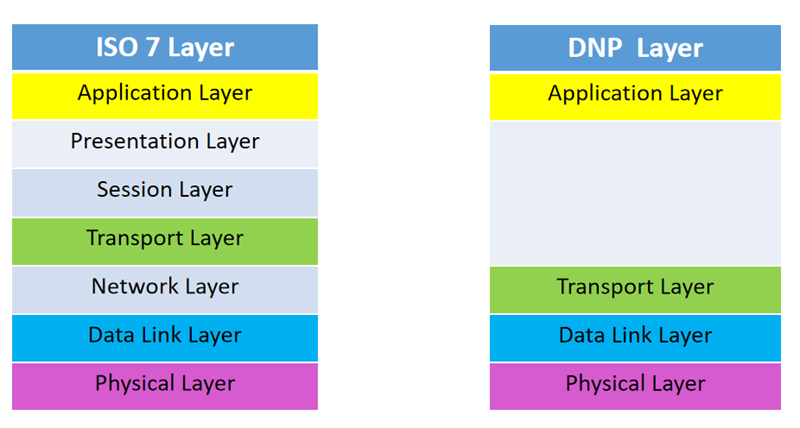
DNP3 is a layer 2 protocol on the OSI model. Further, it defines a transport function (layer 4) and an application layer (layer 7) that defines functions and generic data types for common SCADA applications.
Designed for harsh environments, DNP3 is more robust, efficient, and interoperable than older protocols like Modbus, which is still sometimes preferred for its simplicity.
4. DNP Frame Architecture
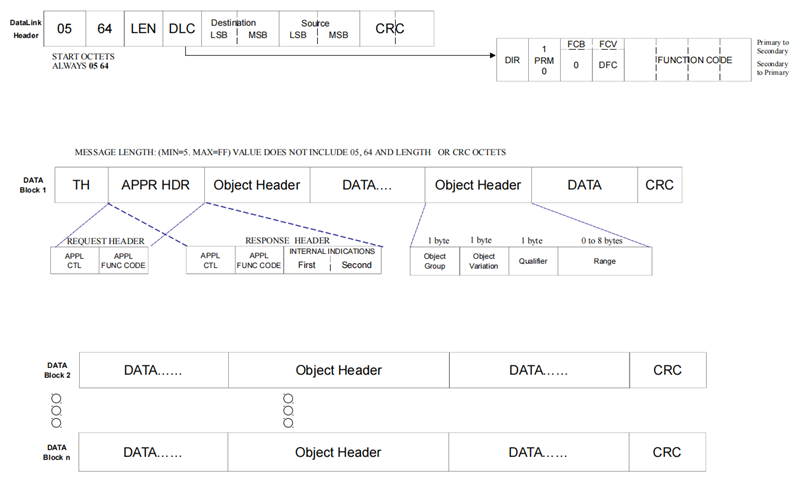
The protocol provides data fragmentation, error detection, multiplexing, link control, prioritization, and layer 2 addressing services.For error detection, it relies on cyclic redundancy check codes. It makes heavy use of cyclic redundancy check codes to detect errors.
5. Protocol Process
5.1. Master-Slave Communication Process
· Master sends a data request (READ/CONTROL)
· Typical communication between a master and a slave involves the following steps
· Slave responds with the requested data (RESPONSE)
· If enabled, the slave may send an unsolicited response when status changes
· Master acknowledges the unsolicited data (CONFIRMATION)
5.2. Control Command Process
· DNP3 control commands follow a two-step process: Select and Operate.
· Master sends a Select command to choose a target object
· Slave confirms target availability
· Master sends an Operate command
· Slave performs the operation and returns a result
5.3. Common Data Types
· Binary Input: Digital status inputs (Object 1)
· Analog Input: Analog sensor readings (Object 30)
· Binary Output: Remote control outputs (Object 10)
· Counter: Accumulative counters (Object 20)
· Time and Date: Time synchronization and timestamps (Object 50)
· File Transfer: File operations (Object 70)
Stage | Description |
Link Setup | Serial or TCP/IP framing with addressing |
Data Acquisition | Polling by class with timestamp & quality flags |
Unsolicited Events | Event-triggered transmission with confirmation |
Control Execution | SBO/DO methods with optional authentication |
Time Sync | Write time or delay compensation |
File Services | Firmware/config updates and device diagnostics |
6. Application Scenarios
· Electric Power Systems: RTU communication with substations, remote control, metering, and faulty localization.
· Water Management: Pump station monitoring, water level/pressure sensing, and leak detection.
· Oil & Gas: Valve control, gas flow monitoring, and remote site inspection.
· Railway Signaling: Signal status monitoring and centralized control communication.
· Renewable Energy: Wind/solar farm data acquisition and remote control.
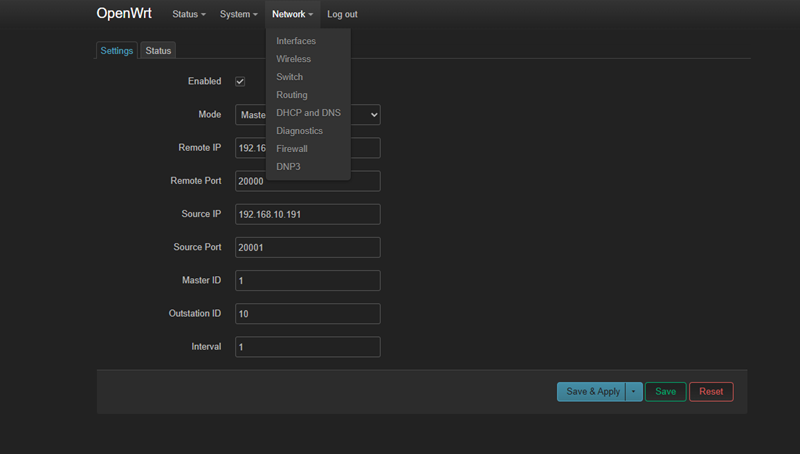
7. DNP in WLINK Router
-- The end


