





HOME < Technology < How 5G/4G Industrial Routers Build Reliable IIoT Connectivity
Introduction
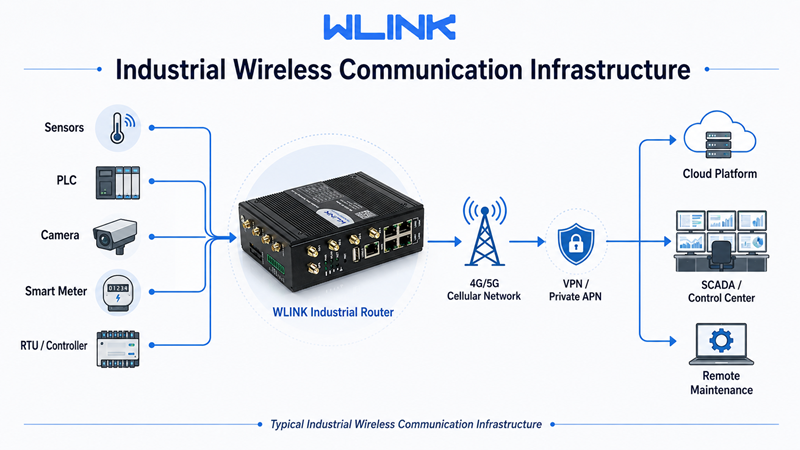
With the popularity of Industry 4.0 and the Industrial Internet of Things (IIoT), people focuses naturally gravitates toward intelligent sensors, cloud-native analytics, and AI-driven optimization.. Yet there is a critical component that frequently escapes the spotlight: the industrial router. Without reliable connectivity, even the most advanced sensors and analytics platforms cannot deliver meaningful value. Industrial routers serve as the essential bridge between field devices, operational networks, and cloud platforms, ensuring that data moves securely and reliably across even the most demanding industrial environments.
The industrial router market is projected to grow from USD 9.03 billion in 2025 to USD 16.91 billion by 2032, reflecting a compound annual growth rate of 9.36%. This growth is propelled by the convergence of Industry 4.0 initiatives, private cellular networks, cloud-based monitoring, and increasingly stringent cybersecurity requirements for operational technology. At the heart of this transformation lie 5G and 4G industrial routers, which are redefining what reliable IIoT connectivity means in practice.
Unique Demands of Industrial Environments
Industrial deployments differ fundamentally from office or consumer networking scenarios. Manufacturing facilities, utility substations, water treatment plants, renewable energy sites, transportation systems, and remote agricultural operations all present harsh and unforgiving conditions. These environments demand continuous operation, high reliability, and remote accessibility—requirements that consumer-grade networking equipment simply cannot meet.
Unlike enterprise routers, industrial routers are engineered for extended temperature ranges, vibration, electrical noise, redundant power supplies, DIN-rail mounting, and long lifecycle support. A network interruption in an industrial setting can result in lost operational data, reduced visibility, delayed maintenance responses, production downtime, and increased operational costs. This is why connectivity infrastructure must be purpose-built for industrial conditions rather than adapted from commercial off-the-shelf solutions.
Industrial 4G Routers——The Foundation of IIoT Connectivity
While 5G captures headlines, industrial 4G routers remain the workhorse of IIoT connectivity, particularly in scenarios where coverage breadth, cost-effectiveness, and power efficiency are paramount.
Core Capabilities and Performance
4G industrial routers typically deliver speeds of 10–100 Mbps with latency around 30–50 milliseconds, making them well-suited for environmental monitoring, equipment status reporting, and other applications with moderate real-time requirements. Operating in the 2.4 GHz frequency band, they offer strong signal penetration and extensive coverage, making them ideal for remote areas or mobile scenarios such as vehicle-mounted devices and outdoor inspections.
The "Digital Nervous System" of Smart Manufacturing
In smart manufacturing environments, industrial 4G routers function as the "digital nervous system" that determines whether the entire IoT ecosystem can operate efficiently. They act as multilingual translators, converting protocol "dialects" from different devices—Modbus, Profibus, and others—into universal languages like TCP/IP or MQTT. This capability enables seamless integration of equipment from multiple vendors, breaking down the information silos that have historically plagued industrial automation.
Field data confirms the tangible benefits: smart factories using industrial-grade 4G routers experience 76% lower network failure rates and save over 40% in long-term operations and maintenance costs compared to those relying on consumer-grade alternatives.
Rugged Design for Harsh Conditions
Industrial environments are far from benign. Extreme temperatures, electromagnetic interference, and sudden power outages are routine challenges. Industrial 4G routers address these challenges through redundant design (dual power supplies and dual SIM cards), metal housing that shields against electromagnetic interference, and watchdog technology that enables automatic recovery during system crashes. These routers typically operate reliably across temperature ranges from -40°C to 75°C, far exceeding the capabilities of commercial networking equipment.
Industrial 5G Routers——The New Frontier in IIoT Connectivity is Rapidly Maturing
5G technology represents a paradigm shift for industrial wireless communication. The core differences between 4G and 5G manifest across five dimensions—frequency band, speed, latency, coverage range, and power consumption—which directly determine their suitability across various industrial scenarios.
Unprecedented Speed and Ultra-Low Latency
Industrial 5G routers can achieve theoretical peak speeds of 1–10 Gbps, with practical throughput ranging from 100 Mbps to 1 Gbps and latency as low as 1–10 milliseconds. This dramatic reduction in latency—from 4G's typical 50 milliseconds to 5G's 1 millisecond—is essential for industrial automation and control systems where even minor delays can impact operational effectiveness and safety.
Wlink G535, powered by the Qualcomm SDX62 platform, support 5G SA/NSA with downlink rates up to 3.4 Gbps, delivering the bandwidth and low latency required for HD video backhaul, remote monitoring, and large-scale data collection.
Support for Advanced 5G Features
Wlink 5G industrial routers leverage 3GPP Release 16 and 17 features, including 5G Standalone (SA) and Non-Standalone (NSA) modes, network slicing, and ultra-reliable low-latency communication (uRLLC). These capabilities enable end-to-end quality-of-service guarantees, deterministic latency, and the segmentation of network resources for different industrial applications.
The adoption of 5G Standalone deployments, 3GPP Release 16/17 industrial features, and Time-Sensitive Networking (TSN) are reshaping router specifications and expanding the addressable use cases for industrial wireless connectivity.
Private 5G Networks
Perhaps the most transformative development is the rise of private 5G networks in industrial environments. 5G's low-latency architecture, network slicing potential, and improved uplink performance are especially relevant for mobile robots, machine vision, predictive maintenance, and distributed energy systems. Industrial routers like the WL-G525 are purpose-built for private LTE and 5G networks, offering native support for CBRS, Anterix, and FirstNet bands, enabling utilities and infrastructure operators to deploy secure private wireless networks without depending exclusively on public carrier connectivity.
The Key Technologies of Building Reliability
Dual-SIM Redundancy and Failover
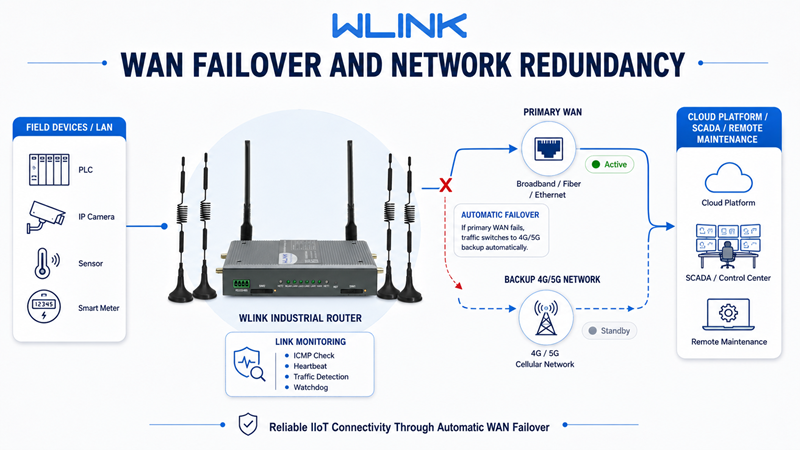
Network availability is critical for industrial applications. Dual-SIM technology enables automatic switching between carriers when connectivity issues occur, reducing downtime and improving service continuity. The WLINK 5G/4G Series incorporate dual-SIM failover to ensure uninterrupted connectivity for mission-critical deployments. The WLINK dual-modem dual-SIM 5G/4G routers take this further enabling automatic failover and remote carrier switching. Especially, Wlink 5G/4G industrial router supports failover between wired and cellular links, includes dual SIM slots for carrier redundancy, and features link health checks together with hardware and software watchdogs that enable automatic reconnection and recovery, minimizing downtime in 24/7 environments.
Multi-Layer Security
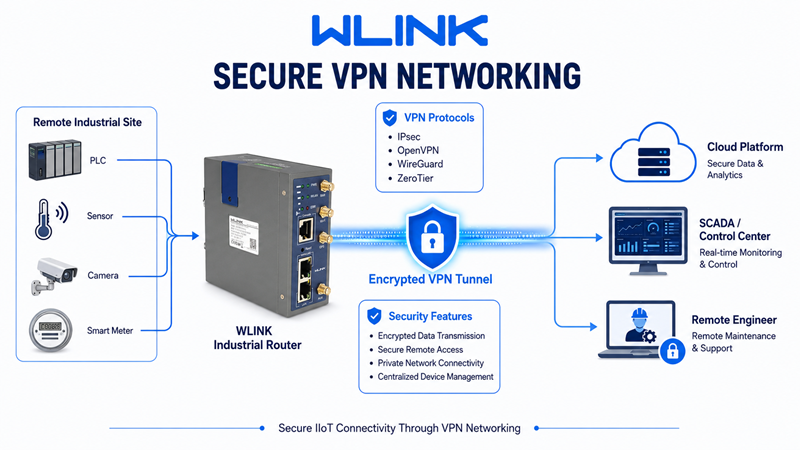
Security in industrial networks is non-negotiable. Industrial routers build multi-layered defenses through VPN encryption tunnels (IPsec, L2TP, OpenVPN, Zerotier, WireGuard), firewall rulebases with SPI and DDoS protection, access control lists, and zero-trust access frameworks. The convergence of stricter cybersecurity requirements, including standards such as IEC EN18031 Cybersecurity, is pushing buyers toward routers with secure boot, signed firmware, role-based access, and auditable patch processes.
Edge Computing Capabilities
Industrial routers are evolving from simple connectivity devices into intelligent edge computing platforms capable of data filtering, protocol conversion, local analytics, event processing, and edge application hosting. This evolution reduces bandwidth consumption while improving response times, and crucially, during network outages, routers with edge computing capabilities can maintain local control strategies to ensure uninterrupted production.
Cloud-Based Management
Centralized, cloud-based management platforms have become essential for managing distributed industrial router fleets at scale. The WLINK's WMCP platform enables network status, signal quality, and traffic usage monitoring from a single dashboard, with configuration updates and firmware upgrades pushed in bulk. Remote diagnostics and maintenance reduce on-site visits and shorten mean time to repair, helping IT and OT teams operate more efficiently.
Typical Applications
Smart Manufacturing
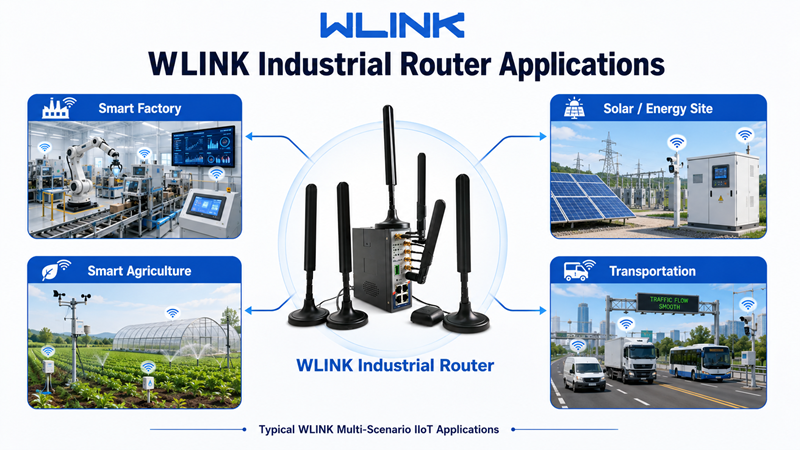
In manufacturing facilities, industrial routers connect PLCs, HMIs, SCADA systems, sensors, and edge gateways, enabling data collection, remote diagnostics, and operational visibility. 5G routers facilitate real-time control of automated guided vehicles (AGVs) with millisecond-level responses for multi-vehicle coordination, minimizing collision risks. The integration of dual-band Wi-Fi 5 or Wi-Fi 6 provides reliable wireless access for multiple concurrent clients where cabling is impractical.
Energy and Utilities
Water, gas, and electricity providers use industrial routers to connect remote assets including smart meters, pump stations, distribution cabinets, and renewable energy sites. The WL-RT600 Series 4G/5G IIoT gateways support RS-232/485 and Digital I/O interfaces, enabling real-time telemetry for oil and gas telemetry and environmental monitoring.
Transportation Systems
Industrial routers are increasingly deployed in rail systems, fleet vehicles, traffic control systems, and passenger information networks. WLINK R230 and G930 Series 5G/4G Transit Gateway, with E-Mark, EN50155 certifications, ensure real-time vehicle tracking, passenger Wi-Fi, and in-vehicle system connectivity.
Smart Agriculture
Agriculture presents one of the most challenging yet rewarding frontiers for industrial wireless connectivity. Vast farmlands, lack of wired infrastructure, and harsh outdoor conditions demand rugged, reliable networking solutions. Industrial 4G/5G routers/gateways are now the backbone of precision agriculture, enabling real‑time data acquisition, automated control, and remote management across crop farming, greenhouse operations, and livestock production.
Conclusion
Industrial wireless communication infrastructure, anchored by 5G and 4G industrial routers, is the foundation upon which reliable IIoT connectivity is built. These purpose-built devices bridge the gap between field devices and cloud platforms, providing the ruggedness, reliability, security, and performance that industrial environments demand. While sensors generate data and cloud platforms deliver insights, industrial routers remain the essential infrastructure that keeps industrial operations connected.
The choice between 4G and 5G is not binary but contextual: 4G routers continue to excel in coverage breadth, cost-effectiveness, and power efficiency for remote monitoring and moderate-throughput applications, while 5G routers unlock new possibilities in ultra-low-latency control, high-bandwidth video analytics, and private network deployments. Together, they form a comprehensive connectivity ecosystem that is accelerating the digital transformation of industry—one reliable connection at a time.


